
“How are my competitors running ads everywhere — and I’m struggling to get clicks?”
The answer usually isn’t luck. And it’s rarely just budget.
Most winning advertisers don’t guess what works. They study competitor ads, track patterns, and improve on proven ideas.
Today, AI makes it easier than ever to spy on competitor ads online — legally, ethically, and intelligently.
This guide will show you:
- How to spy on a competitor the right way
- How to track competitors’ ads across platforms
- How to analyze competitor ads using AI
- The best free and paid ad spy tools
- What to learn from ads (and what never to copy)
What “Spying on Competitor Ads” Actually Means
Let’s clear up a common misunderstanding.
Spying does NOT mean:
- Hacking ad accounts
- Stealing creatives
- Copying ads word-for-word
Spying DOES mean:
- Observing publicly available ads
- Tracking ad behavior over time
- Studying messaging, offers, and structure
- Learning what resonates with an audience
Every major ad platform provides transparency tools. You’re simply using them more intelligently — with AI.
Why Competitor Ad Research Matters More Than Ever
Ad platforms are crowded. Audiences are scrolling faster, trusting less, and ignoring generic ads.
If an ad is still running after weeks or months, that’s a strong signal:
- It’s converting.
- It’s profitable.
- The message works.
Competitor ads are real-world test results, not theory. AI helps you process more ads faster, identify patterns humans miss, and turn observation into insight.
How to Spy on a Competitor (The Smart Process)
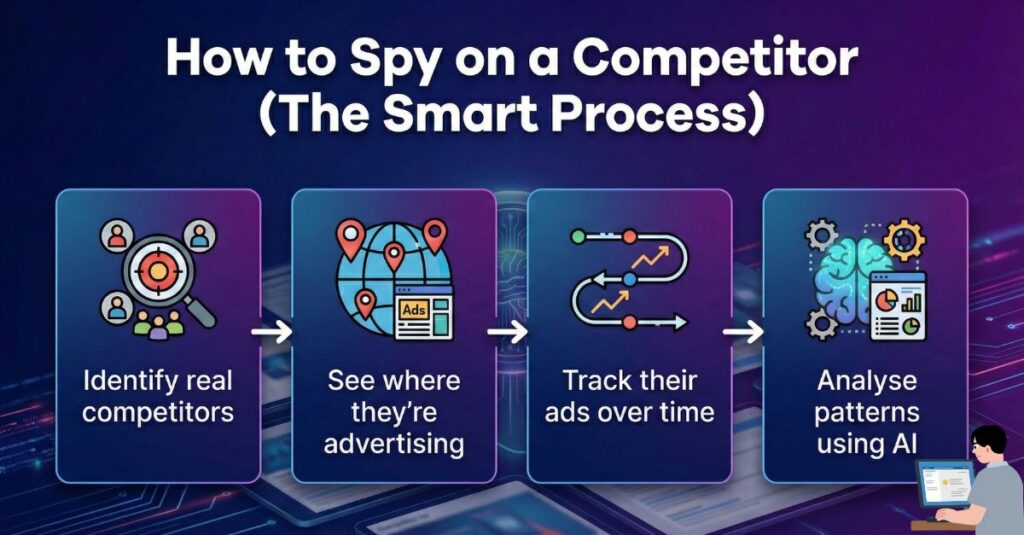
Spying on competitor ads works best when you follow a clear system. The process has four parts:
- Identify real competitors
- See where they’re advertising
- Track their ads over time
- Analyze patterns using AI
Skipping any step weakens the result.
Step 1: Identify Your Real Competitors
Your competitors are not “everyone in the niche.” They are businesses that:
- Target the same audience
- Promote similar offers
- Run ads on the same platforms
Pro Tip: Start with 5–10 competitors. More than that creates noise, not insight.
Step 2: How to See Where Competitors Are Advertising
Before you analyze anything, you need to know where competitors are running ads. Here are the main public sources:
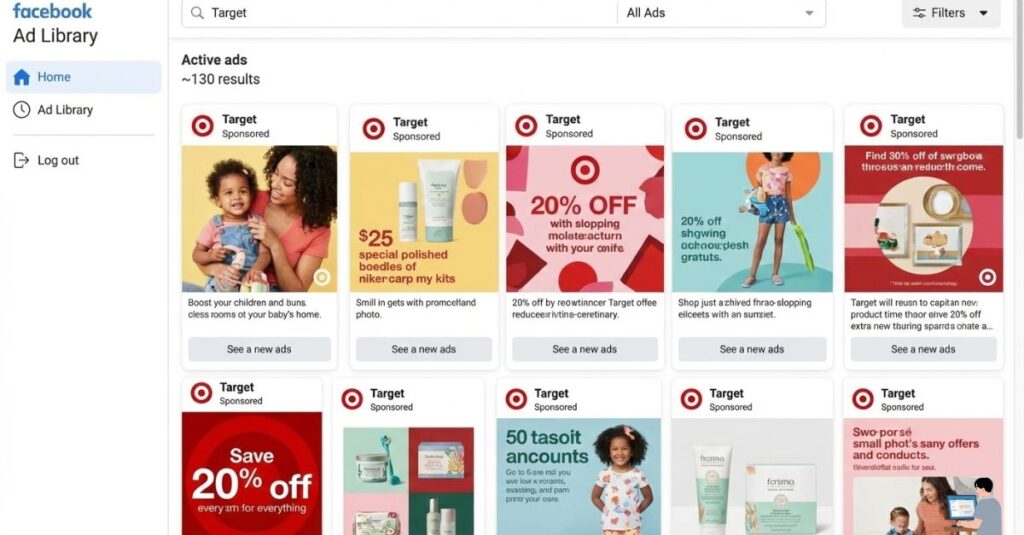
1. Facebook Ad Library (Facebook & Instagram Ad Spy) This is the most popular free Facebook ad spy tool. You can search by brand name, see all active ads, and view copy/creatives.
- What to watch: If an ad has been live for a long time, it’s rarely accidental.
2. Google Ads Transparency Center This helps you track search and display ads.
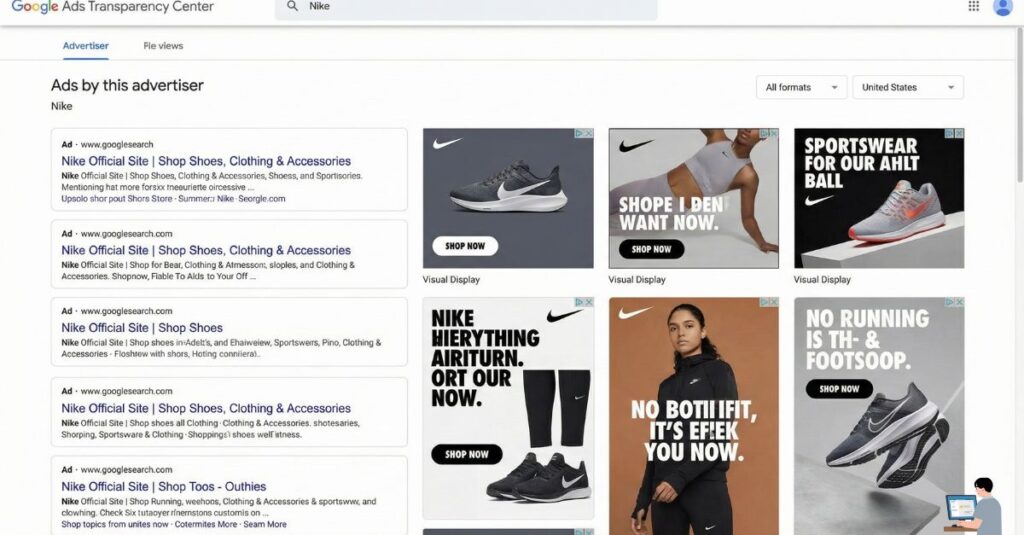
- What to watch: Competitor messaging and keyword intent. This is especially useful when combined with tools like SpyFu.
3. TikTok Creative Center For TikTok advertisers, this is gold. You can see trending ads, filter by industry, and track engagement signals.
- What to watch: It’s one of the easiest ways to spot trends in fast-moving niches.
Step 3: How to Track Competitors’ Ads Over Time
One-time observation isn’t enough. Tracking helps you see which ads disappear quickly versus which ones stay active.
Popular Ad Spy Tools (Free and Paid) You don’t need dozens of tools. You need one or two used properly.
- BigSpy: Supports Facebook, Instagram, TikTok, and Google. Great for discovering patterns quickly across channels.
- SpyFu: Focuses on search ads. Excellent for tracking Google Ads history and PPC strategy.
- Free Options (Still Powerful): Facebook Ad Library, Google Ads Transparency Center, and TikTok Creative Center are more than enough for beginners.
Step 4: How to Analyze Competitor Ads Using AI
This is where most people level up instantly. Instead of staring at ads and guessing, use AI to break them down logically.
What to Feed into AI: You can input ad copy, headlines, CTAs, or even upload screenshots (if using ChatGPT Vision).
Smart Questions to Ask AI:
- “What problem is this ad targeting?”
- “What emotion is being triggered?”
- “What promise is being made?”
- “Who is this ad clearly NOT for?”
- “Why might this ad be converting?”
AI is excellent at pattern recognition, especially when comparing multiple ads from different competitors.
What to Look for When You Spy Ads
Don’t focus only on visuals. Pay attention to:
Offer structure: Discounts, free trials, or bundles?
Tone: Friendly, aggressive, or educational?
Repeated hooks: If several competitors use similar messaging, it’s a signal — not coincidence.
Headlines: Are they asking questions or making statements?
Spy on Competitor Ads: Free vs. Paid Tools
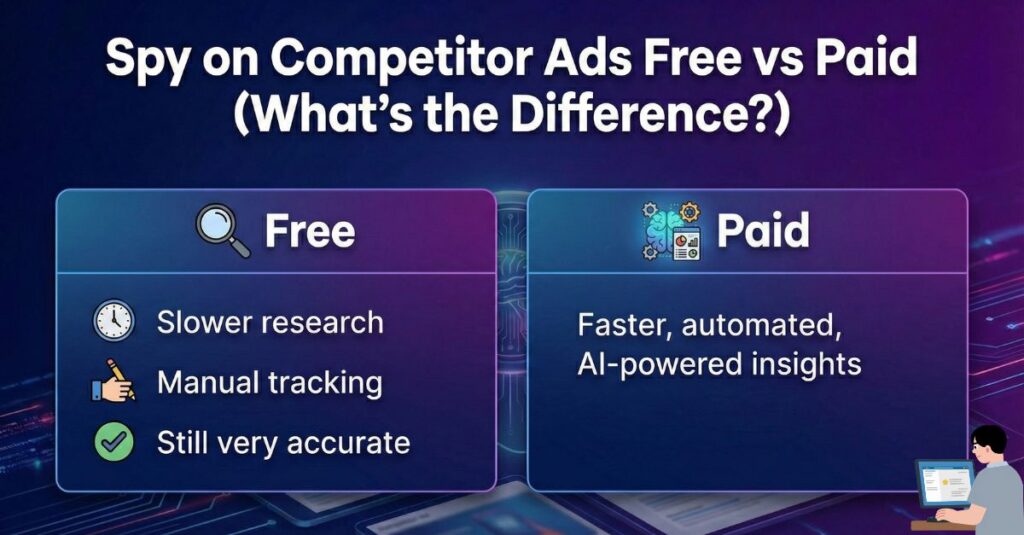
Free Tools
- Pros: Very accurate (official data).
- Cons: Slower research, manual tracking.
Paid Tools
- Pros: Faster discovery, better filtering, historical data.
- Cons: Monthly cost.
Verdict: If you’re just starting, free tools + AI analysis are more than enough.
Common Mistakes People Make When Spying on Ads
Avoid these — they kill results.
- Copying ads instead of learning from them.
- Ignoring audience context.
- Analyzing too many ads at once.
- Chasing trends without testing.
- Letting AI decide strategy blindly.
Remember: AI helps you think clearer — it doesn’t replace thinking.
FAQs: Spying on Competitor Ads Using AI
What’s the best way to spy on competitor ads for free?
The easiest and safest way is using official ad libraries:
- Facebook Ad Library (Meta ads)
- Google Ads Transparency Center
- TikTok Creative Center
These tools show real, live ads. Combine them with AI to analyze patterns, and you won’t need expensive software early on.
Are paid ad spy tools like BigSpy or SpyFu worth it?
They can be — but only after you understand the basics.
Paid tools save time by:
- Tracking ads automatically
- Showing historical data
- Filtering large ad libraries
Free tools + AI are enough for beginners. Paid tools help once scale and speed matter.
How do I legally spy on competitors’ ads (including affiliate ads)?
You’re allowed to:
- View public ads
- Analyze messaging and structure
- Learn from patterns
You should never:
- Copy creatives
- Reuse brand names
- Impersonate competitors
Used correctly, ad research is standard market analysis — not spying in a bad way.
How can I see where my competitors are advertising across platforms?
Check if they appear on:
- Meta (Facebook/Instagram)
- Google (Search & Display)
- TikTok
If a brand runs ads on multiple platforms at the same time, it usually means the campaign is working.
Does AI actually help analyze competitor ads, or is it hype?
AI helps organize and summarize, not replace thinking.
It’s great for:
- Identifying repeated hooks
- Spotting common angles
- Comparing multiple ads quickly
It still needs human judgment to decide what fits your audience and brand.
Can AI-generated ads really perform well?
They can — when used correctly.
AI works best when you:
- Give clear context
- Understand the audience
- Use it for refinement, not automation
AI-written ads fail when people expect instant results without strategy.
How do I identify winning hooks and angles in competitor ads?
Focus on:
- The first 3 seconds
- Repeated opening lines
- Ads that run for weeks
Long-running ads usually indicate a hook or angle that’s working.
How do I find gaps in competitor messaging using AI?
Compare multiple ads and ask:
- What does everyone mention?
- What does no one explain clearly?
- What pain point feels ignored?
Messaging gaps are often where the best opportunities exist.
How can I tell if a competitor’s ad matches their landing page?
Look for consistency:
- Same promise
- Same problem
- Same tone
If the ad and landing page feel disconnected, conversions usually suffer.
Final Truth (Why This Works)
The best ads aren’t created in isolation. They’re observed, studied, and improved.
AI doesn’t give you winning ads automatically. It removes guesswork and speeds up understanding.
If you want better ads, stop guessing — and start learning from what already works.