You just got the job offer. Congratulations!
The salary looks great. The title is fancy. You are ready to sign on the dotted line.
Stop.
Buried in those 15 pages of “standard legal text” could be clauses that destroy your work-life balance, steal your side-hustle rights, or ban you from working in your industry for two years if you quit.
Hiring a lawyer to review your contract costs $500+. But in 2026, you can use AI to do a “Red Flag Review” for free—if you know how to do it safely.
In this guide, I will show you how to securely use AI to spot the hidden traps in your employment contract and avoid the dreaded “Fake Job” scams plaguing LinkedIn.
Table of Contents
Safety First: The “Redaction Protocol”
WARNING: Never upload a raw legal contract to a public AI tool (like standard ChatGPT). It might be used to train the model, and you could violate a Non-Disclosure Agreement (NDA) before you even start.
The Fix: You must “sanitize” the document first.
- Open the contract in Word or Google Docs.
- Use “Find and Replace” (Ctrl+H) to swap:
- Your Name $\rightarrow$
[CANDIDATE] - Company Name $\rightarrow$
[EMPLOYER] - Specific Salary $\rightarrow$
[$SALARY]
- Your Name $\rightarrow$
- Save this new “Clean Version” as a PDF. Now it is safe to upload.
Step 1: The “Red Flag Scanner” Prompt
Don’t just ask “Is this good?” The AI will be too vague. You need to perform a specific Red Flag Review.
Copy This Prompt:
“Act as an Employment Lawyer. I am uploading the anonymized text of a job offer/contract. Scan this text for the following 5 Key Risks:
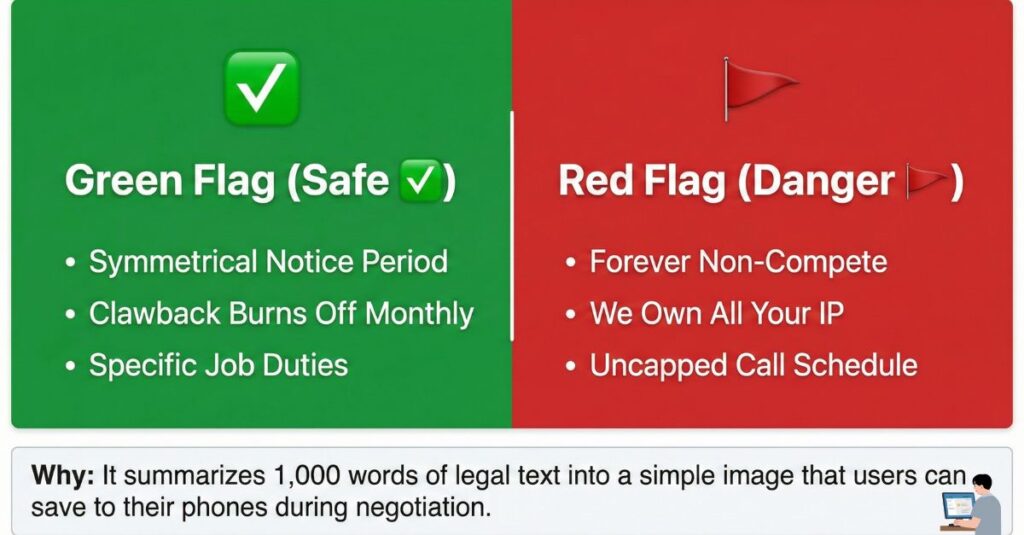
1. Non-Compete Clauses: Are there restrictions on where I can work after leaving? (Flag any time limit > 6 months).
2. IP Ownership: Does the company claim ownership of things I create on my own time (side projects)?
3. Termination Terms: Is the notice period symmetrical? (e.g., If I have to give 2 months’ notice, do they?)
4. Clawbacks: Are there rules forcing me to pay back my sign-on bonus or training costs if I leave?
5. Role Definition: Is the job description vague (e.g., ‘and other duties as assigned’)?”
Step 2: The Big 3 Traps to Watch For
1. The “Forever” Non-Compete
- The Trap: You quit, and the contract says you can’t work for any competitor for 2 years.
- 2026 Update: While the FTC tried to ban these, the ban was blocked in court. In 2026, Non-Competes are still legal in many states (though banned in California, Minnesota, and others).
- The Fix: Ask AI: “Is this non-compete enforceable in [Your State]?” If you live in a “Blue Pencil” state, a judge might rewrite it; in “Red Pencil” states, the whole clause might be void.
2. The “Side Hustle” Stealer (IP Clauses)
- The Trap:“Company owns all inventions developed during the term of employment.”
- Translation: If you write a book or code an app on your weekend, they own it.
- The Fix: Negotiate a “Carve-Out Clause” that says: “Excluding works created on employee’s own time, without use of company equipment.”
3. The “Stay-or-Pay” Trap (Training Repayment)
- The Trap: They offer “Free Training,” but if you quit within 24 months, you owe them $10,000. These are called TRAPs (Training Repayment Agreement Provisions).
- 2026 Update: New laws (like California’s AB 692 and New York’s “Trapped at Work Act”) have made these strictly regulated or illegal effective 2026.
- The Fix: Ensure the clawback “burns off” over time (e.g., the debt reduces by 1/24th every month you stay).
Step 3: Niche Warnings (Physicians, Sales, & Tech)
Certain jobs have unique traps. If you are in these industries, look for these specific keywords:
| Industry | The Hidden Trap | What It Means |
| Physicians | “Tail Coverage” | Who pays for malpractice insurance after you leave? (Can cost $50k+). If silent, YOU pay. |
| Sales | “Windfall Clause” | Can they cap your commission if you close a “too big” deal? Ensure there is no cap. |
| Tech/Devs | “Moral Rights” | Did you waive your right to be credited for your code? |
Bonus: How to Spot “Fake Job” Scams
Sometimes the contract isn’t bad—it’s fake. Scammers use Fake Job Postings to steal your identity.
The “Scam Check” Checklist:
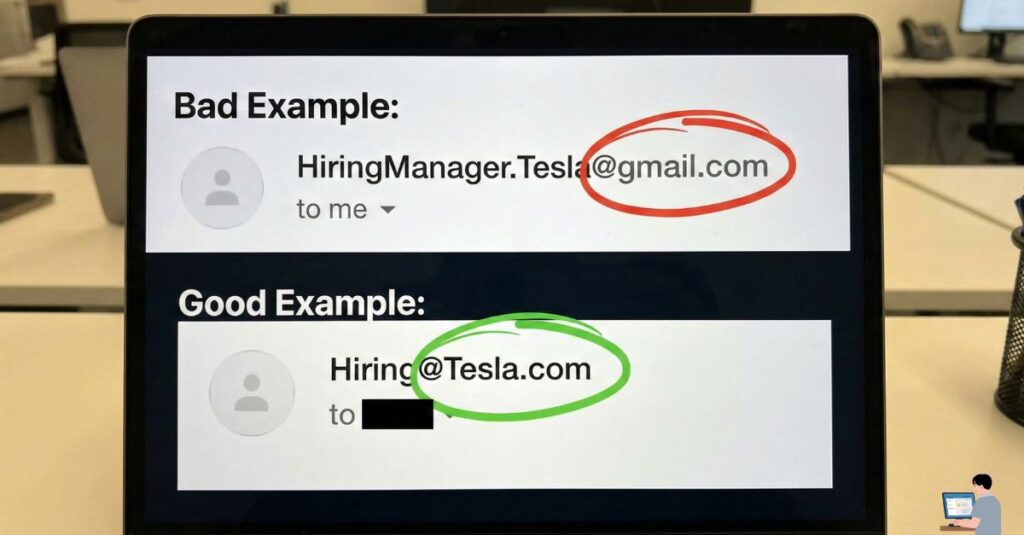
- The “Gmail” Test: If the recruiter emails you from
@gmail.comor@yahoo.cominstead of@company.com, it is 100% a scam. - The “Instant” Offer: Did you get the job without a video interview? (e.g., Text-only interview via Signal/WhatsApp). Real companies do not hire via text.
- The “Check” Scam: They send you a check to “buy home office equipment.” Do not cash it. The check will bounce, and you will lose the money you sent to their “vendor.”
Pro Tip: If you see a job on Indeed, go to the Company’s Official Career Page. If the job isn’t listed there, the Indeed post is likely fake.
Video Insight: 5 Red Flags in Job Offers
Want to hear an expert break down these clauses? Watch this video by “A Life After Layoff” (a top Corporate Recruiter channel) on what to look for before you sign.
(Video Title: 5 Job Offer Red Flags You Should Never Ignore)
FAQ: Real User Queries Answered
Q: Are digital employment contracts enforceable?
A: Yes. Clicking “I Agree” or signing via DocuSign is legally binding in the US, UK, and most of the world. Treat a digital signature exactly like a pen-and-paper one.
Q: What is the “3 Month Rule”?
A: This usually refers to the Probation Period. In many countries, employers can fire you without cause during the first 90 days. Red Flag: If the probation period is longer than 6 months, they might be using it to avoid giving you benefits.
Q: Can I negotiate the standard contract?
A: Yes! Recruiters often say “It’s just our standard template,” but almost everything is negotiable. Focus on the Non-Compete and Severance terms. They likely won’t change the “IP Clause,” but they will add a side-letter protecting your specific side hustles.
Final Verdict: Trust Your Gut (And Your AI)
An employment contract governs your life for the next few years. It determines when you wake up, how much you earn, and what you can do if you quit.
Spending 10 minutes anonymizing and scanning it with AI can save you years of regret.
Tools to Use:
- ChatGPT/Claude (For the Red Flag Scan).
- LegalRobot (For deep legal analysis).
- Glassdoor (To check if the “Company” actually exists).