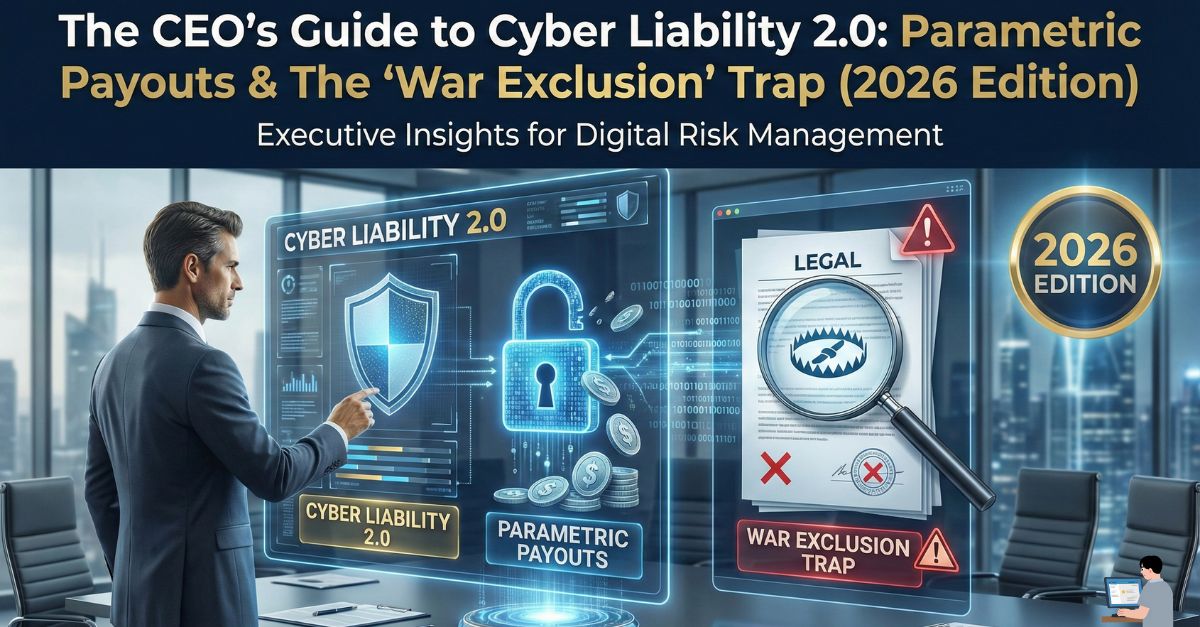
If you are a CEO relying on a standard Cyber Liability Insurance policy in 2026, you may be exposed to a massive coverage gap: The “State-Backed” Attack Exclusion.
The commercial insurance market has hardened. Carriers are no longer just raising premiums; they are rewriting the rules of engagement. With global cybercrime costs projected to hit $10.5 trillion this year, insurers are aggressively limiting their exposure to systemic risks like cloud outages and geopolitical cyberwarfare.
This executive briefing covers the three advanced strategies Tier 1 organizations are using to survive the 2026 threat landscape, moving beyond simple “insurance” to sophisticated Risk Transfer Mechanisms.
1. The “War Exclusion” Mandate: Are You Covered?
The most critical update for 2026 is the strict enforcement of the Lloyd’s of London “War Exclusion” Clauses.
- The Risk: If your company is hit by a ransomware gang linked to a hostile government (e.g., APT groups affiliated with nation-states), your insurer may classify this as an “Act of War” rather than a criminal act.
- The Consequence: “Acts of War” are standard policy exclusions. In 2026, insurers are using advanced forensic attribution to deny claims for state-sponsored attacks, leaving enterprises with zero coverage for their most sophisticated threats.
- The CEO Move: Negotiate a “Cyber-Terrorism Carve-Back.” You must ensure your policy explicitly covers state-backed attacks provided war has not been formally declared by a government. Do not accept the standard language.
2. The New “Problem Solver”: Parametric Cloud Insurance
Traditional Business Interruption Insurance takes months to pay a claim because you have to prove your losses forensically. In 2026, the cloud is the single point of failure. If AWS or Azure goes down for 12 hours, you lose millions immediately.
Enter Parametric Insurance (The 2026 Game Changer):
Unlike traditional indemnity policies, Parametric Insurance does not reimburse loss; it pays based on a data trigger.
- The Mechanism: You buy a policy that states: “If Cloud Region US-East-1 is down for >4 hours, payout is $5 Million.”
- The Benefit: Zero Claims Adjustment. The moment the downtime hits the trigger index, the wire transfer is automatic.
- Why You Need It: Standard cyber policies often have a “Waiting Period” (12-24 hours) before coverage kicks in. Parametric covers that immediate cash flow gap, ensuring liquidity during a crisis.
3. The “Pixel” Litigation Wave: A Hidden Liability
A massive, under-reported trend in 2026 is “Pixel Litigation” (CIPA/VPPA lawsuits).
- The Issue: Plaintiff attorneys are using AI bots to scan millions of corporate websites for tracking pixels (like the Meta Pixel or Google Analytics) that share video viewing data without explicit consent.
- The Cost: These are class-action lawsuits demanding statutory damages ($2,500 per violation).
- The Coverage Gap: Many cyber policies exclude “Wrongful Collection of Data” unless specifically added.
- Action Item: Check your Regulatory Defense Limits. They are often sub-limited to $100k, which is insufficient for a class action defense. You need a dedicated Media Liability endorsement.
4. The “Captive” Strategy: When Premiums are Too High
For enterprises facing $2M+ in annual premiums, buying commercial insurance is becoming mathematically inefficient.
The Strategy: Fortune 500 companies are forming Single-Parent Captives (essentially, their own insurance company).
- The Economics: Instead of paying $5M to a commercial carrier, you pay $5M into your own Captive entity.
- Year 1: The Captive buys Reinsurance for catastrophic losses (e.g., claims over $10M) but retains the first $10M of risk.
- Year 5: If you have low claims, that $25M in premiums (plus investment income) sits on your balance sheet, not the insurer’s.
- 2026 Trend: Captives are now accessing ISO 27001-certified reinsurance markets directly to lower costs.
5. Compliance Alert: The ISO 27001:2022 Deadline
Crucial Update: If your CISO tells you the company is “ISO 27001 Certified,” ask: “Is it the 2013 or 2022 standard?”
The transition period officially ended on October 31, 2025.
If you are still holding a 2013 certificate in February 2026, you are non-compliant. Insurers will view this as a lapse in governance, potentially voiding your policy conditions or spiking your renewal rate by 30%.
Executive Summary: 2026 Cyber Budgeting
| Strategy | Est. Enterprise Cost | ROI / Strategic Benefit |
| Cyber Liability (Traditional) | $250k – $1M+ | Essential for legal defense & notification costs. |
| Parametric Cloud Cover | $50k – $200k | Immediate cash liquidity during cloud outages. |
| ISO 27001 Audit | $50k – $100k | Lowers insurance premiums by ~20%. |
| Captive Formation | $75k (Setup) | Long-term wealth retention & tax efficiency. |
Final Word for the Board:
In 2026, Cyber Liability is not a commodity you buy off the shelf. It is a complex financial instrument. If your broker isn’t talking to you about Parametric Triggers or War Carve-Backs, you are likely underinsured for the modern threat landscape.