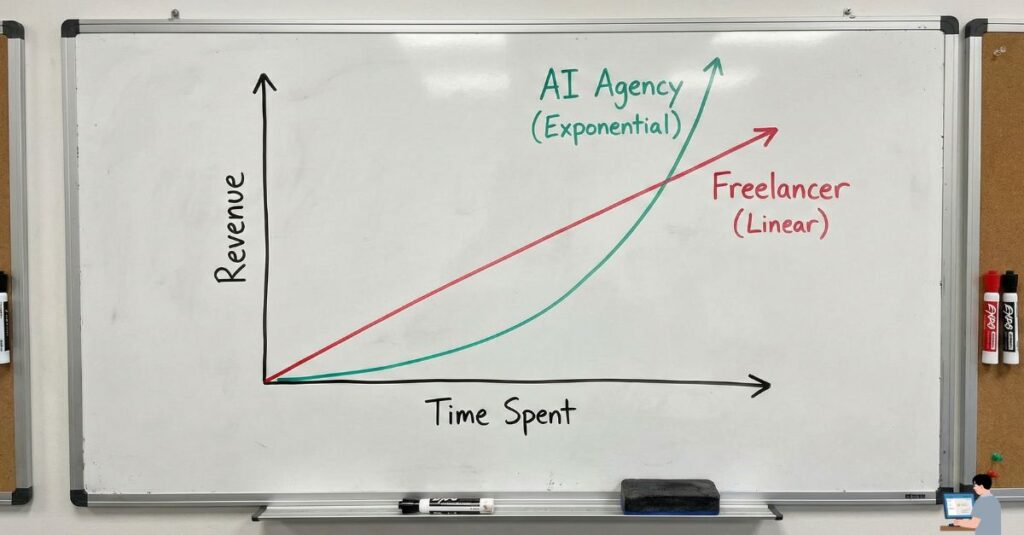
If you are a specialized service provider—whether in digital marketing, technical writing, or systems design—you are likely familiar with the “scalability ceiling.” You deliver high-quality work, but your revenue is tethered strictly to your billable hours. To grow revenue, you must essentially work more hours.
This is a linear model in an exponential world.
The transition from a solo consultant to a scalable agency requires a fundamental shift in your business architecture. It is no longer about increasing headcount to handle more work; it is about deploying Business Process Automation (BPA).
By pivoting to an “AI-First” infrastructure, you can decouple your income from your time, offering enterprise clients the reliability, consistency, and speed they demand.
Phase 1: The Shift to “Operational Scalability”
Traditional agencies attempt to scale by hiring junior staff. This increases overhead, management stress, and margin erosion. Modern agencies scale by optimizing workflow logic.
The Efficiency Gap Analysis
In my analysis of B2B operations, I often find that nearly 70% of billable time is consumed by administrative redundancy—manual data entry, routine lead qualification, report generation, and scheduling.
Consider the difference in these two operational models:
| Feature | The Linear Model (Freelancer) | The Automated Model (Agency) |
| Core Asset | Your Personal Time | Intellectual Property (IP) & Code |
| Deliverable | Manual Execution | Turnkey Systems |
| Scalability | Capped by Hours in a Day | Infinite (Cloud Compute) |
| Client Value | “Labor” (Commodity) | “Infrastructure” (High Value) |
The Strategic Pivot
By adopting the Automated Model, you position your services not as “labor” to be managed, but as “digital infrastructure” to be licensed. Corporate clients are willing to pay premium retainers for systems that reduce their internal operational overhead and eliminate human error.
Phase 2: High-Value B2B Automation Architectures
To attract enterprise-level retainers and move away from hourly billing, you must solve expensive business problems. Here are three high-demand service architectures you can implement using compliant, low-code tools.
1. Automated Customer Experience (CX) & Support
Modern consumers demand instant responsiveness. A manual support team cannot scale indefinitely without eroding profit margins.
- The Problem: Hiring 24/7 human support agents is cost-prohibitive for most mid-sized companies.
- The Solution: Intelligent Conversational Agents.
- The Implementation: Using platforms like Voiceflow or Intercom, you can build decision-tree logic that resolves Tier-1 support tickets automatically. This isn’t just a “chatbot”; it is a first-line defense that handles password resets, scheduling, and basic FAQs.
- The Value: You are offering 24/7 Customer Continuity, increasing the client’s Net Promoter Score (NPS) while significantly reducing their support payroll.
2. CRM Data Hygiene and Lead Scoring
Sales departments lose significant revenue due to “data decay” and slow response times.
- The Problem: High-paid Sales Directors waste hours manually entering data or chasing “cold” leads.
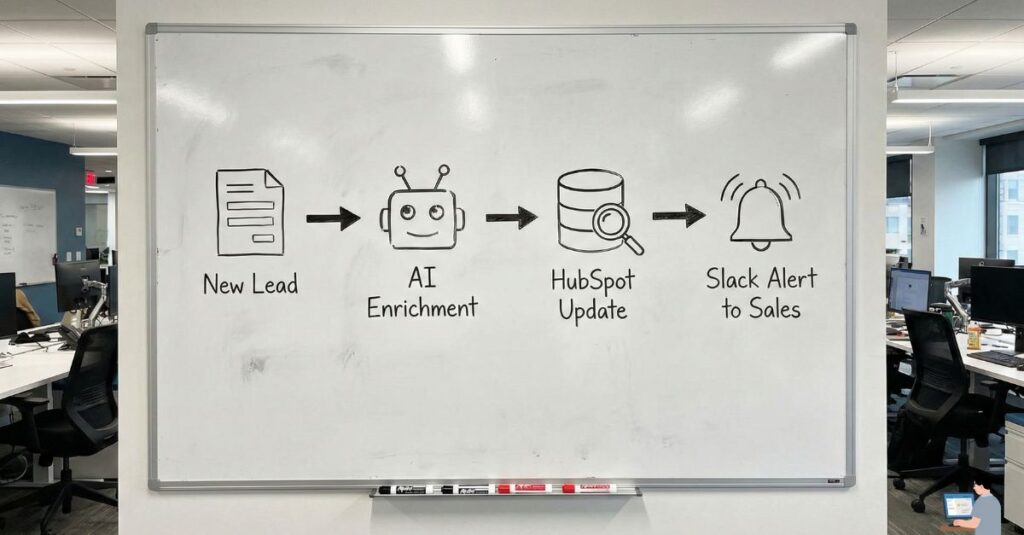
- The Solution: A “Zero-Touch” Lead Qualification Engine.
- The Workflow: By integrating a CRM (like HubSpot or Salesforce) with an automation layer (like Make), you can build systems that automatically enrich lead data from third-party sources (like Clearbit) and route high-value accounts directly to senior staff.
- The Benefit: This ensures your client’s expensive sales team focuses only on Sales Qualified Leads (SQLs), maximizing their Return on Ad Spend (ROAS).
3. Content Operations Ecosystems
Consistency is the hardest part of corporate communication.
- The Problem: Marketing teams burnout trying to produce content for LinkedIn, Twitter, Blogs, and Newsletters simultaneously.
- The Solution: AI-Assisted Content Supply Chains.
- The Workflow: You build an automated system that creates a “first draft” pipeline. It takes raw inputs (like a webinar transcript or a whitepaper) and utilizes Large Language Models (LLMs) to atomize that content into newsletters, social summaries, and blog posts.
- The Result: The client achieves a robust Omnichannel Presence without increasing headcount.
Phase 3: The Integration Strategy (No-Code Development)
A common misconception is that this level of automation requires advanced software engineering or Python coding skills. In reality, the modern agency runs on No-Code Integration Platforms (iPaaS).
The Enterprise Tech Stack: To offer these services, you need to master three specific layers of technology:
- The Orchestration Layer: Tools like Zapier or Make (formerly Integromat) act as the “digital glue.” They listen for triggers (e.g., “New Email Received”) and execute actions (e.g., “Save to Database”).
- The Intelligence Layer: API connections to models like GPT-4 or Claude 3 provide the reasoning capabilities to analyze text, summarize data, or generate replies.
- The Data Structure Layer: Systems like Airtable or PostgreSQL house the operational logic and customer records securely.
Your value as an agency owner lies in architecting these connections. You identify the bottleneck, map the logic, and deploy the solution.
Phase 4: Pricing Your Automation Services
Moving from hourly billing to value-based pricing is critical for compliance and profitability. Do not sell “hours of coding.” Sell “efficiency.”
- Setup Fee (The Build): Charge a one-time fee for designing and implementing the workflow. This covers your architectural expertise.
- Retainer Fee (The Maintenance): Charge a monthly recurring fee to monitor, update, and optimize the automations. API updates break things; your retainer ensures business continuity.
Example Structure: Instead of charging $50/hour to manually process leads, you charge a $2,500 setup fee to build the Lead Scoring Engine, plus a $1,000/month retainer to ensure it keeps running smoothly. The client saves money compared to hiring a full-time employee, and you gain predictable revenue.
Frequently Asked Questions (FAQ)
Q: Is No-Code automation reliable for enterprise use?
A: Yes. Modern platforms like Make and Zapier are SOC2 compliant and used by Fortune 500 companies. Reliability comes from proper error-handling architecture, which is part of the service you provide.
Q: How does this differ from just using ChatGPT?
A: ChatGPT is a tool; Automation is a system. A tool requires a human to type prompts. A system runs in the background, triggered by data events, without human intervention. You are selling the system, not the tool.
Q: Do I need to know how to code?
A: While logic skills are required, traditional coding is not. The “No-Code” movement allows you to build complex software logic using visual drag-and-drop interfaces.
Conclusion: From Operator to Architect
The market does not pay for effort; it pays for solved problems.
By pivoting your business toward AI Automation Services, you stop competing on price in a crowded freelance market. Instead, you enter the high-value sector of Digital Transformation Consulting, offering clients the one asset they cannot buy elsewhere: efficient, scalable freedom.